
Classic Heathland & Atlantic Links
28. Juli 2026
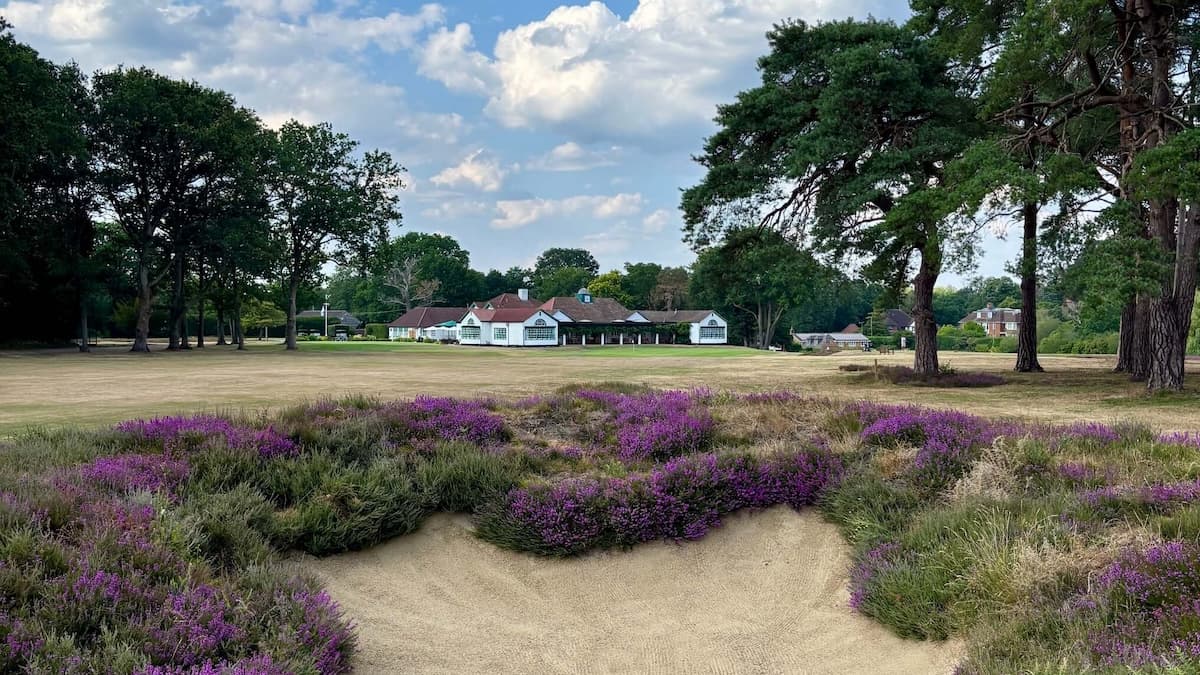
Classic Heathland & Atlantic Links is a short golf blog post that looks at my recent trip, discovering some hidden gems in the South of England.
Trading the historic turf of St Andrews for a grand tour across the South of England is always an exciting prospect.
Having spent over 30 years in the golf industry and building tailored golf itineraries, I am constantly seeking out routes that seamlessly blend world-class course architecture with top-tier hospitality.
This Familiarisation (FAM) trip took me from the heather-lined fairways of Surrey, then down to the dramatic coastal dunelands of North Devon, through the Cotswolds, and back again. Below is the exact step-by-step journal of the journey, covering every flight, fairway, and historic hotel along the way.
The Flight: Edinburgh (EDI) to London Heathrow (LHR)
The itinerary began with an early morning flight on British Airways from Edinburgh Airport (EDI) to London Heathrow (LHR).
Clocking in at just under an hour and 15 minutes, this air link is one of the most efficient travel connections for golfers coming down from Scotland or connecting through London’s primary international hub.
Within 30 minutes of grabbing my bags, we were off the tarmac and driving through the quiet pine corridors of Surrey.
Woking Golf Club
My first golfing stop was Woking Golf Club, where we were introduced to Scott Clark, Managing Director.
He gave us a tour of the clubhouse and some history of the course.
The club was founded in 1893 on Hook Heath and originally laid out by Tom Dunn.
Woking is widely celebrated as the spiritual birthplace of modern strategic golf course architecture.
At the turn of the 20th century, members John Low and Stuart Paton undertook a quietly revolutionary redesign, most famously placing two centerline bunkers in the middle of the fairway on the 4th hole. Rather than demanding brute distance, these bunkers forced golfers to choose a strategic line to open up the best angle into a cleverly contoured green. Running alongside the London-to-Woking railway line, Woking features springy heathland turf, thick patches of heather, and multi-tiered putting surfaces (such as the hourglass green on the 13th) that test every facet of your short game.

The Castle Hotel, Windsor
After a brilliant afternoon on the heathland, we made the short drive north to The Castle Hotel in Windsor.
Situated directly on the High Street, just steps from Windsor Castle and the Royal Mews, this Georgian property has operated as a hostelry since the 15th century. Combining historic period features with modern, refurbished boutique bedrooms, it serves as an exceptional base for visiting golf groups playing the Surrey and Berkshire golf belts. The central location makes exploring Windsor’s historic cobblestone streets and dining options effortless after a day on the course.
The main building is now undergoing a major refurb, which promises to catapult the hotel into the modern day, while keeping the main historical features.

St George’s Hill Golf Club
Day two kicked off at St George’s Hill Golf Club in Weybridge, designed in 1912 by master architect Harry Colt.
Carved out of private estate land defined by steep ridge lines, soaring Scots pines, and mature rhododendrons, St George's Hill is a visual and architectural masterpiece. The layout comprises three 9-hole loops (Red, Blue, and Green), with the Red and Blue forming the championship 18.
Colt made incredible use of the undulating terrain, placing green sites on natural elevated plateaus and carving dramatic fairways through the heather.
The round culminates at the 18th hole, playing up towards one of the most iconic, stately clubhouses in the world of golf.

Hotel Du Vin, Bristol City Centre
Moving west toward the coastal courses of the South West, our evening base was the Hotel Du Vin in Bristol city centre.
Occupying a collection of restored 18th-century sugar warehouses (known historically as The Sugar House), this boutique hotel blends exposed brickwork, dark wood, and industrial heritage with luxury comfort. It features a fine-dining French bistro and an extensive wine cellar. Located in the heart of Bristol, it offers visiting golfers an urban atmosphere and nightlife options when transitioning between Surrey's heathlands and Devon's links.

Burnham & Berrow Golf Club (Championship Course)
Just under an hour south of Bristol on the Somerset coast lies Burnham & Berrow Golf Club, a classic 9-out-and-9-back links layout bordering the Bristol Channel.
Originally laid out by Charles Gibson in 1890 and refined over the decades by J.H. Taylor, Harry Colt, and Alister MacKenzie, Burnham & Berrow is a regular host of Open Championship Regional Qualifying and major amateur events. The course winds through tall natural sand dunes, where steep-faced pot bunkers, firm running fairways, and heavy coastal winds demand precise ball-striking.
Highlights include the short par-4 3rd playing toward the landmark parish church tower, and a series of punishing par 3s that require absolute distance control.

Saunton Sands Hotel & Spa, Saunton
Crossing into North Devon, we checked into the Saunton Sands Hotel, perched dramatically on the cliffs overlooking the vast golden sands of Braunton Burrows and Bideford Bay.
This Art Deco luxury hotel offers sweeping panoramas of the Atlantic Ocean, elegant AA-Rosette dining, and the multi-level Source Spa & Wellness centre.
Featuring thermal suites, outdoor heated pools, and marine-inspired treatments, it provides an ideal recovery environment for golfers tackling the surrounding links.


The Royal North Devon Golf Club
Located across the Taw & Torridge estuary in Westward Ho, The Royal North Devon Golf Club (RND) is the oldest seaside links course in England, founded in 1864.
Laid out by Old Tom Morris, playing RND feels like stepping directly into a living golf museum. The course sits on the flat, common grazing land of Northam Burrows, where sheep and horses still roam freely across the fairways. There are no standard yardage markers—only 150-yard rocks. Notable architectural features include the legendary 4th hole with its massive, sleeper-faced "Cape" bunker (one of the widest hazards in golf) and the punishing "Giant Rushes" on the back nine. Inside the historic clubhouse, a world-class collection of memorabilia honours founding member and 5-time Open Champion J.H. Taylor.
Inside the clubhouse, you are surrounded by historic artefacts, which transport you back in time to the golden age of hickory shafts, plus fours & feathery balls.

Saunton Golf Club (East Course)
The next morning brought us to Saunton Golf Club’s East Course, a Herbert Fowler design from 1919 (later restored by C.K. Cotton after WWII) set deep within the Braunton Burrows Biosphere Reserve.
Consistently ranked among the Top 30 courses in the UK & Ireland, the East Course weaves through massive natural sand dunes without ever feeling artificial or forced. It is a formidable test of championship golf: eight of its par 4s stretch past 400 yards, requiring long, accurate tee shots into firm, heavily guarded greens.
Sir Nick Faldo once famously noted that the East Course is big and tough enough to host an Open Championship.

The Golf Tourism England (GTE) Convention
Hosted directly on-site at Saunton Sands Hotel, the 'Golf Tourism England' Convention served as the central hub of the trip.
The event was sponsored by Discover South Carolina, which have sponsored the event for the whole 7 years of it's existence.
Bringing together UK and international golf tour operators, destination management companies, resort directors, and golf media, the event featured networking sessions, industry presentations, and strategic roundtables.
The convention highlighted the growing global demand for English golf, particularly itineraries that pair London-adjacent heathland with coastal South West links.
Organised by Andrew Cooke and Victoria Snow, with help from Seb Roberts, the event took place without a hitch.

Saunton Golf Club (West Course)
Following the convention proceedings, we took to Saunton’s West Course.
Originally designed by Fowler in 1935, the course was cleared for military training during World War II and rebuilt by Frank Pennink in the 1970s.
While slightly shorter on the scorecard than its sibling, the West Course sits deeper in the dunes closer to the estuary.
It presents a tighter, more intricate test where strategic positioning off the tee is crucial to avoid sunken dune slacks and pot bunkers.
Playing both the East and West back-to-back offers one of the finest 36-hole links days anywhere in Great Britain.

The Manor House Hotel & Golf Club, Castle Combe
Turning back east toward Wiltshire, we arrived in the village of Castle Combe to experience The Manor House Hotel & Golf Club.
The hotel is a 14th-century country house set within 365 acres of secluded Cotswold countryside, featuring the Michelin-starred Bybrook Restaurant.
Designed in 1992 by Peter Alliss and Clive Clark, the 18-hole championship golf course routes through dense oak and beech woodlands.
It features extreme elevation changes, tiered greens, and water hazards created by the meandering River Bybrook.
The standout signature hole is the Par 3, 17th hole, dropping steeply from a high cliff to a green nestled across the stream far below.


Royal Berkshire Hotel, Ascot (Site-Visit)
Heading back into the home counties, our next stop was the Royal Berkshire Hotel in Sunninghill, near Ascot.
Built in 1705 for Charles Howard, the 1st Earl of Carlisle, this country house hotel is steeped in history and sits surrounded by 15 acres of landscaped gardens.
It sits in the epicentre of the Berkshire and Surrey golf golden triangle—just minutes from Sunningdale, Wentworth, and The Berkshire.
With plush contemporary rooms, excellent dining, and tranquil walled gardens, it offers a refined, peaceful retreat ideal for travelling golf groups looking to recharge before tackling the final heathland stretch.

Pennyhill Park Hotel, Bagshot
Our final overnight stay brought us to Pennyhill Park Hotel in Bagshot, Surrey.
Set in 123 acres of rolling parkland, this 5-star country house hotel is famous for housing an award-winning 45,000 sq ft spa facility (featuring outdoor hydrotherapy pools, ice caves, and thermal suites) and Michelin-starred dining at The Latymer.
As the official long-term training base for the England Rugby Team, Pennyhill Park delivers high-end luxury, making it an exceptional luxury base.


West Hill Golf Club (Site-Visit)
Leaving Pennyhill Park, we headed straight to West Hill Golf Club in Brookwood, completing another cornerstone of the legendary heathland circuit.
Designed in 1907 by Cuthbert Butchart, West Hill consistently ranks among England's top 100 courses.
Framing fairways lined with heather and majestic Scots pines, the course is bisected by the Brookwood Brook, which comes into play on several tricky holes.
The greens are notoriously fast, undulating, and pure, demanding soft hands and precise distance control on approach.
Its classic layout has remained virtually unchanged for over a century, offering a tranquil, timeless heathland experience.

Worplesdon Golf Club
To cap off the entire FAM tour, we played Worplesdon Golf Club in Woking, completing the celebrated "Three Ws" heathland trilogy alongside Woking and West Hill.
Laid out in 1908 by J.F. Abercromby, with greens constructed by Willie Park Jr., Worplesdon is classic Surrey heathland at its finest.
Golden heather, towering Scots pines, and silver birches frame fairways built on a deep sand base.
The course is particularly famous for its signature 10th and 11th holes, where a natural water feature and picturesque wooden footbridge come into play, offering a scenic and architectural conclusion to a memorable tour across the South of England.

The itinerary finished with me being dropped off at LHR, well in time for my evening flight back to EDI.
The flight was delayed, as most evening flights are, and I arrived in EDI 30 minutes late for my ride back home.
On reflection, this was one of the best Fam Trips that I have been on.
For those in the know, beware of the 'Pigeon' and keep 'The Code'
What are your thoughts on Classic Heathlands & Atlantic Links?
What is your favourite English Heathland Course or Links Course?
To read more of my golf blog posts, click here.